
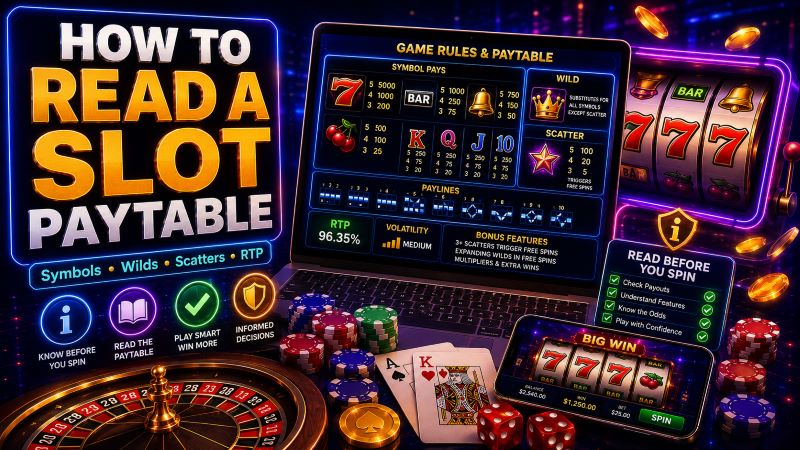
I used to click SPIN immediately after loading a new game; no need to review the Paytable, I’d quickly take my chances and watch as my credits went spinning and reels spun. One evening, however, I landed what I believed to be a nice win; 5 symbols matched, creating a winning combination and the payout was 8 credits on a 20-credit bet. I said eight! As I stared at a relatively low-paying symbol throughout the entire game and mistakenly assumed it was one of the better symbols due to its animation and color, that’s the exact night I began to study the Paytable prior to clicking SPIN for the first time, and it altered the amounts I won and lost in ways unrelated to luck.
The Paytable is essentially a game’s User Manual, and viewing it as optional reading is one of the most common and costly behaviors new players exhibit. The Paytable details which symbols provide what payoffs, how the paylines function, what triggers the bonus round (if applicable), and what is the largest possible payoff for a given game. The information itself is generally located somewhere within the game, perhaps two clicks away, but nearly everyone waits until a problem occurs or a large win appears less substantial than anticipated before taking a peek.
Where to find the Paytable
The majority of Video Slots have the Paytable accessible via an Info Button (usually represented by an “i” or a “?”) within the Game Interface, either on mobile devices or computer browsers. In addition, some older or simplified Slot Machine Interfaces combine multiple sections onto a single scroll screen, making it easier to read in one pass. Regardless of format, it is recommended to examine the Paytable prior to funding your account with real money rather than post facto.

Fortunately, demo mode provides a method for testing a game while simultaneously verifying the Paytable data for each feature. Running 10 – 20 free spins in demo mode while referencing the Paytable teaches you far more about the flow of a game than could any review of the game. I personally make a practice of examining the Paytable immediately upon starting a new game prior to pressing the first SPIN button, since once your credits are depleted, it becomes far more difficult to remain objective regarding whether a particular payout seemed reasonable based upon the paytable data provided.
Low-Paying Symbols vs. High-Paying Symbols
While every online slot divides its symbols into general categories or tiers (regardless of whether or not such distinctions are clearly labeled as such on the paytable), symbols in low-paying positions are nearly always stylized versions of Card Royalty (Ten through Ace) and generally offer payouts ranging from 0.1x to 1x total bet for five consecutive occurrences of the low-payout symbol. Consequently, these lower-paying symbols appear more frequently than their higher-paying counterparts due to the mathematical model utilized by online slots. Symbols that are categorized as high-paying symbols include those that represent the central theme of a slot machine and may include Pharaohs, Dragons, Fruit in Classic Style Games, etc., and generally provide significantly larger payouts (often 5x to 50x bet or greater) for achieving five consecutive instances of the higher-paying symbol. However, reviewing the actual numbers associated with each symbol is significantly more important than relying on your instincts as to which symbols appear visually appealing. I have witnessed numerous examples of slot machines where a mid-tier symbol offers greater payouts than a flashier symbol solely due to how the developer has weighted the mathematical model of the slot machine. To determine which option is correct, you must verify the values associated with each symbol listed directly under each symbol entry within the paytable.
Wilds, Scatters, and Special Symbols
Special symbols within slot machines are where paytables truly become valuable since it is here that you will discover the actual mechanics of gameplay that can greatly influence your gaming session. Wild Symbols substitute for all other symbols except for Jackpot Symbols and/or Scatter Symbols (even if they appear to substitute for all other symbols). Most paytables specifically identify which symbols cannot be substituted for by Wild Symbols. Furthermore, certain Wild Symbols possess their own monetary values or carry multipliers (doubling/tripling the winnings generated from a successful outcome utilizing that Wild Symbol) and identifying these characteristics can be easily overlooked if you fail to carefully examine the entry associated with that Wild Symbol. Triggering a free spins round that can re-trigger creates completely different scenarios compared to a bonus round that has an absolute limit (ceiling) on additional spins added during the re-triggers.
I have experienced gaming sessions in which triggering a re-triggered free spins round resulted in transforming 10 free spins into 35, whereas other gaming sessions using non-re-triggering games were capped at an upper limit on spins added during subsequent attempts. Bonus Symbols that are displayed separately from Scatter Symbols provide access to Pick-and-Click Features/Mini-Games/Jackpot Wheels and are described in detail in separate entries within the paytable as each mechanism varies greatly among developers.
Payline Structure & Ways to Win
Many people experience difficulty understanding how to interpret payline structure as opposed to merely observing how the reels spin. While payline structure is defined within a slot machine’s rules, it is not necessarily apparent without actively searching for it.
Fixed Payline Structures mean that all lines are active every time you spin; i.e., you have no control over which lines are activated. Fixed payline structures continue to be prevalent in both classic 3 reel slots and various forms of contemporary video slots. Selectable Payline Structures allow players to decide which paylines(s) to enable. Selectable paylines were more common previously but are now less so since enabling fewer paylines allowed players to unintentionally decrease their win potential in order to save credits/spins per spin. All-Ways-Pay structures eliminate paylines altogether and instead award payouts when adjacent reels contain matching symbols regardless of vertical positioning.
Cluster Pays go even farther by eliminating paylines and ways-to-win altogether and instead reward payouts when a cluster of matching symbols land on top of one another. Neither form is superior; however, both alter how you interpret a win. For example, on an all-ways-play slot machine, three matching symbols appearing on adjacent reels can result in a payout despite being positioned vertically off-center, and most all-ways-pay slots will display their total ways-to-win somewhere on their initial opening screen allowing you to avoid confusion as to why you receive a payout where you did not expect it.
RTP & Volatility & Information that is NOT Included within Paytables
Return to Player (RTP) is typically stated as a percentage within the Paytable or Info Section. Commonly, RTP ranges from approximately 92% to 98%, although both factors depend on both the individual game and operator configurations. The Return to Player percentage represents a hypothetical long term average across millions of spins rather than a prediction of your upcoming session’s performance. Treating RTP as a short-term indicator is a common mistake I made myself for far too long.
A 96% RTP game can consume an entire $50 bankroll in just ten minutes on an unfavorable run. High-Volatility games award infrequent payouts yet often produce massive awards (upwards of 500x – 5,000x bet or greater) on top combinations. Sessions on these types of games can consist of prolonged periods with little activity prior to one spin producing a major impact. Whether or not volatility is explicitly described in numbers directly on the paytable depends on the developer’s presentation style; however, volatility is present within most paytables either in a descriptive label (e.g., low-medium-high), or graphic representation. The maximum win figure is an equally vital piece of data to locate and understand as well; this figure describes the upper bound on a single spin or bonus round as a multiplier of your total bet (e.g., 2000x – 10,000x).
A Quick Review Before Committing Real Money
Upon loading a new slot machine today, I perform a brief mental checklist prior to initiating my first real-money spin. Overall, this process requires roughly two minutes. Verify that both high-paying and low-paying symbols are correctly identified along with their respective multipliers rather than relying on perceived visual importance. Confirm how your wild symbol functions including whether it replaces any scatter symbols/jackpot symbols.
Identify how many scatters initiate the bonus rounds, and whether any portion thereof may retrigger. Locate/pay attention to how many lines/ways you can play based on your chosen bet-size/structure and understand why you did/didn’t win based upon that knowledge. Finally, glance at RTP/volatility percentages for insight into your session’s prospects. This basic review has likely protected me more money in the last decade alone than any strategy document ever could … primarily by avoiding excessive frustration stemming from misinterpreting either wins or losses.
Terms & Fine Print Associated with Progressive Jackpots
Progressive Jackpots warrant a more deliberate review than other aspects contained within paytables as terms associated with progressive jackpots are typically more limiting than players anticipate. Many progressive jackpots only reward players who initiated their winning spin at MAX BET; thus, players placing lesser wagers may generate jackpot symbols but receive substantially less or no additional funds above their base prize for triggering the progressive jackpot.
Other progressive jackpots require players to initiate the progressive jackpot by completing specific bonus rounds or random events (in lieu of achieving a specific combination of symbols); unfortunately, none of these probabilities are typically disclosed anywhere (including paytables) as developers consider this probability information proprietary.
Similarities Between Paytables & Casino Bonus Terms
As referenced earlier, free spins terms carry unique restrictions as well; therefore, paytables are distinct from casino bonus terms despite similarities in wording. A free spins section within a paytable explains in-game mechanics: how many free spins will be awarded, what multiplier (if any) will apply during free spins; whether free spins will utilize player-set betsizes or will employ a default betsize for free spins.